
Air Duct Cleaning: Repair or Replace? How Ballantyne Homeowners Decide
Cleaning a duct system with a collapsed flex run is like washing a car with a cracked windshield. You can do it, and it’ll look better for a while, but you haven’t touched the thing actually causing the problem, and the next cleaning will find the same result. Most Ballantyne homeowners never get told which of these they’re facing. Cleaning, repair, and replacement are three different answers to three different conditions, and the camera inspection is what tells you which one applies.
What’s the difference between duct cleaning, duct repair, and duct replacement?
Cleaning removes contamination from a sound system. Repair fixes physical damage while keeping the existing layout. Replacement happens when the ductwork itself can’t perform anymore because of age, material failure, or a layout that doesn’t match your HVAC equipment. The right call depends on what the ducts are made of, how they’re routed, and whether the joints and liner are intact.
A quick distinction helps: cleaning addresses what’s in the ducts, repair addresses what’s wrong with the ducts, and replacement addresses whether the ducts can still do their job at all. A Ballantyne home with an intact 2015 system and ordinary dust buildup needs cleaning. A 1990s house with crushed flex runs in the attic needs repair first, then cleaning. A house where the trunk line was sized for a smaller unit than the one now sitting in the mechanical closet needs a harder conversation.
Here’s what each category looks like:
- Clean-only: intact system, normal contamination, no visible damage at the registers, joints holding, liner smooth and continuous.
- Repair-then-clean: damage present but the layout is sound. A disconnected joint, a crushed run, a torn liner section, or a poorly sealed boot at the register.
- Replace: duct material failing throughout, layout incompatible with the current HVAC tonnage, or a system so deteriorated that repairs would be a patchwork with no end.
If you’d rather not sort this out from a ladder in the attic with a flashlight, call (855) 726-7841 and we’ll take a look.
What does a camera inspection actually reveal?
A camera inspection shows what you can’t see from the vent covers: the inside surface of the duct runs, the condition of the joints, and the state of the liner. From the vent cover to the air handler, the camera travels the whole path. What we’re looking for falls into three recognizable patterns.
Collapsed flex duct looks exactly like it sounds. The inner liner has folded in on itself, flattening the cross-section of the run. From a register, the airflow just feels weak. From a camera, it’s unmistakable: a duct that was supposed to be round is now a pinched crescent. Cleaning a collapsed run is wasted effort because you’re cleaning a tube that no longer carries the air it was designed to.
Disconnected joints show up as a gap between two duct sections, often taped at one time and now loose. Air escapes into the attic or crawlspace instead of reaching the room. In Ballantyne homes, these often hide behind insulation where nobody’s looked in years. A joint that’s been disconnected for a while also pulls unfiltered attic air into the system every time the blower runs.
Deteriorated liner on older flex duct shows as flaking, torn, or separated inner material. The liner is what keeps fiberglass particles out of the airstream, so once it’s compromised, cleaning doesn’t restore the system’s integrity. A camera pass tells you whether you’re looking at cleanable contamination or a liner that needs replacing.
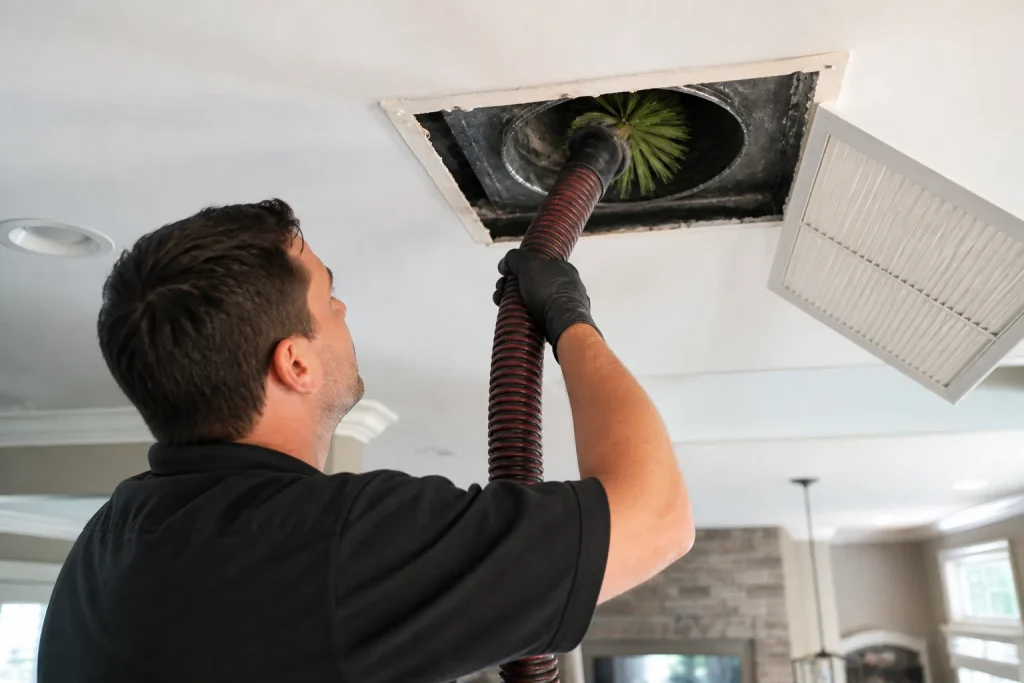
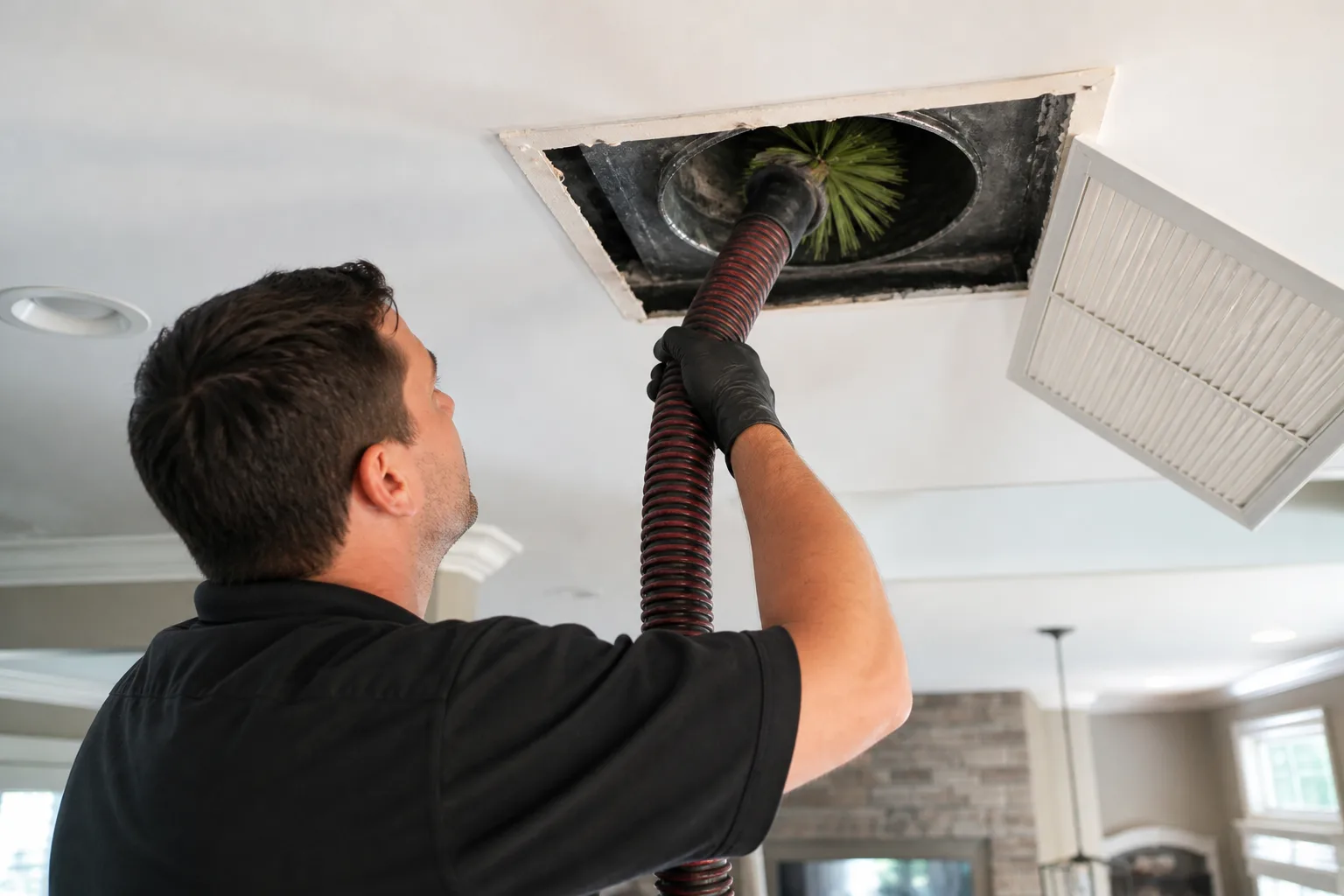
Rotary brush and vacuum systems like the Rotobrush and Nikro equipment we use are built to work inside ducts that are still structurally sound. They’re excellent at removing debris. They can’t straighten a crushed run or reattach a joint, which is why the camera pass comes before the equipment goes in.
What does the age and material of a Ballantyne home tell you?
Homes built before 2000 often carry duct configurations that were sized for the HVAC equipment of that era, not the unit currently in the closet. When a system gets replaced and the new unit has different tonnage, the ductwork that was adequate for the old equipment may now be undersized, oversized, or routed in ways that create pressure problems on one side of the house and weak airflow on the other.
This is the scenario that trips up a lot of Ballantyne homeowners. They call for a cleaning expecting better airflow, the ducts get cleaned thoroughly, and the airflow problem remains because the ducts themselves don’t match the equipment. Cleaning was the answer to a different question.
- Pre-2000 homes: check for duct sizing vs. current HVAC tonnage, flex runs that have had time to kink or sag, and joints that were sealed with older methods and have since failed.
- 2000-2010 homes: generally better duct layout, but original flex duct can be at the point where liner deterioration starts showing. Camera inspection settles it.
- Recent construction or renovation: the duct system is usually sound, but construction dust, drywall debris, and renovation particles are the main cleaning driver. Clean-only is the typical category.
Material matters too. Rigid metal ductwork holds up well but can develop loose joints and internal corrosion at the seams. Flex duct is faster to install and quieter, but the inner liner is the part that fails first, and once it starts deteriorating, no amount of cleaning brings it back.
How much does duct repair cost before replacement makes more sense?
There’s no universal tipping point, but there is a reasonable framework. The decision comes down to the repair cost weighed against the remaining life of the duct system and the HVAC equipment it serves. When repair estimates start approaching the cost of a partial replacement, repair stops being the smart move. When the duct layout is fundamentally wrong for the current HVAC equipment, repair doesn’t solve the underlying problem no matter how much you spend on it.
Here’s how we walk through it:
- Count the problem runs. If one or two runs are damaged and the rest of the system is sound, targeted repair is almost always the right call.
- Assess the remaining HVAC life. If the furnace or air handler is near the end of its service life, replacing duct sections that will be sized for a new unit is sometimes the smarter sequencing.
- Compare repair cost to partial replacement cost. Partial replacement of the worst runs is often less disruptive and less expensive than a full-system job, and it can restore most of the performance.
- Ask whether cleaning is even worth doing before the underlying damage is fixed. Cleaning a system with multiple disconnected joints means cleaning again after repair. Repair-then-clean is the correct order.
Estimates are free and the written estimate sets the final price, so you’re not making this call on a guess. If the ducts in your Ballantyne home are giving you trouble and you’re not sure which category you’re in, that’s exactly what the inspection is for.
What does partial duct replacement look like, and when is it the right call?
Partial replacement means replacing the problem runs and keeping the intact sections of ductwork. It’s often the quiet hero of duct decisions, and it rarely gets pitched because it doesn’t sound as dramatic as a full-system replacement. But it’s frequently the correct answer in Ballantyne homes where the trunk line is sound and one or two branch runs are crushed, sagging, or have deteriorated liners.
What a partial replacement involves in practice:
- The camera inspection identifies which runs are failing and which are healthy.
- The failing runs are removed and replaced with duct sized to match the current HVAC equipment.
- Joints are sealed to prevent the leak patterns that caused the original problem.
- The whole system is cleaned after the new runs are in, so the new ductwork isn’t pulling in debris from the untouched sections.
- Sanitizing is the final step, treating the full air pathway rather than just the new sections.
Partial replacement is the smart call when the layout is fundamentally sound but specific runs have failed. Whole-system replacement becomes the smarter call when the duct material is failing throughout, or when the layout itself is the problem. In those cases, replacing one run at a time just delays the inevitable.
The other thing partial replacement solves is airflow imbalance. If one side of the house never gets the same airflow as the other, the cause is often a single collapsed run rather than anything wrong with the HVAC unit itself. Fixing that run and sealing the joints sometimes does more for comfort than any amount of cleaning.
When should you call a pro instead of cleaning it yourself?
The moment you see damage, not just dust. Consumer-grade vacuums and shop vacs can pull surface dust from a register, but they can’t reach the interior of a run, can’t inspect joints, and can’t fix what they find. They also can’t safely handle a deteriorated liner, where loosening material needs to be contained rather than scattered through the house.
Clean, sealed, and sanitized is the sequence that actually resolves the system condition, and that’s the order we work in at Air Duct Cleaning Ballantyne. If the camera shows damage, the repair and sealing happens first. Then the cleaning. Then the sanitizing. That’s the “we find it, we fix it” approach, and it’s why we offer Air Duct Cleaning Ballantyne as a full-system service rather than a one-step vacuum pass.
If the inspection reveals poor indoor air quality driven by contamination rather than damage, our air duct cleaning walks the full pathway and can be followed with sanitizing to address microbial growth and allergens. Honeywell and Aprilaire components handle ongoing filtration and humidity control, and Guardsman filtration products can extend the interval between cleanings without changing the duct itself. When renovation dust is the main driver, cleaning the HVAC cleaning components alongside the ducts keeps the blower and coil from recirculating the debris. And if your system has an attached clogged dryer vent cleaning path, that’s a separate safety issue worth scheduling at the same time. Our technicians have up to 8 years of experience, and they’ll explain what the camera finds before anything gets cleaned.
The Bottom Line
Cleaning, repair, and replacement are three different answers, and the camera inspection is what tells you which one you’re facing. Intact ducts with ordinary contamination: clean them. Damaged runs with a sound layout: repair, seal, then clean. Failing material or a layout that doesn’t match your HVAC equipment: replace, at least partially. If you’re in Ballantyne and need help, Air Duct Cleaning Ballantyne offers free estimates, and we’ll walk you through what the camera sees rather than leaving you to guess.
Call (855) 726-7841. We answer 24/7, and fast dispatch runs from 7am to 7pm, Sunday through Friday.
Frequently Asked Questions
It depends on whether the ducts are damaged, not just dirty. If the camera inspection shows intact ductwork with normal contamination, cleaning is the right call. If it shows collapsed runs, disconnected joints, or deteriorated liners, repair or partial replacement comes first because cleaning a damaged system won’t fix the airflow problem. If the material is failing throughout or the layout doesn’t match your HVAC equipment, replacement is usually the right path. Call (855) 726-7841 for an accurate diagnosis.
Air duct cleaning here is priced per whole system, not per vent, and the written estimate sets the final price after the inspection. That’s deliberate. Per-vent pricing is where the bait-and-switch starts, because the total depends on how many vents the technician counts up once they’re inside. Whole-system pricing means you know the number before work begins. Call (855) 726-7841 for a free estimate.
Usually because the quote doesn’t include the whole system. A low figure often covers a quick pass over the supply registers and stops there, skipping the return side, the air handler, and any joint or liner inspection. The price looks great until the next cleaning finds the same result because the underlying damage was never addressed. Ask any contractor what the quote covers and whether they inspect before cleaning. Call (855) 726-7841 for a frank estimate.
There’s no fixed calendar. A sound system in a home with a well-maintained filter might go years between cleanings. A home that’s been renovated, a home with pets, or a system that’s pulling attic air through a disconnected joint will need attention sooner. The honest answer is to inspect, not to schedule on a timer. That’s why we do the camera pass first. Call (855) 726-7841 and we’ll tell you what your system actually needs.
Written by the team at Air Duct Cleaning Ballantyne.
Need Air Duct Cleaning Help?
Call Air Duct Cleaning Ballantyne - the local pro we connect you with is licensed and insured, with free written estimates in Ballantyne.
(855) 726-7841