
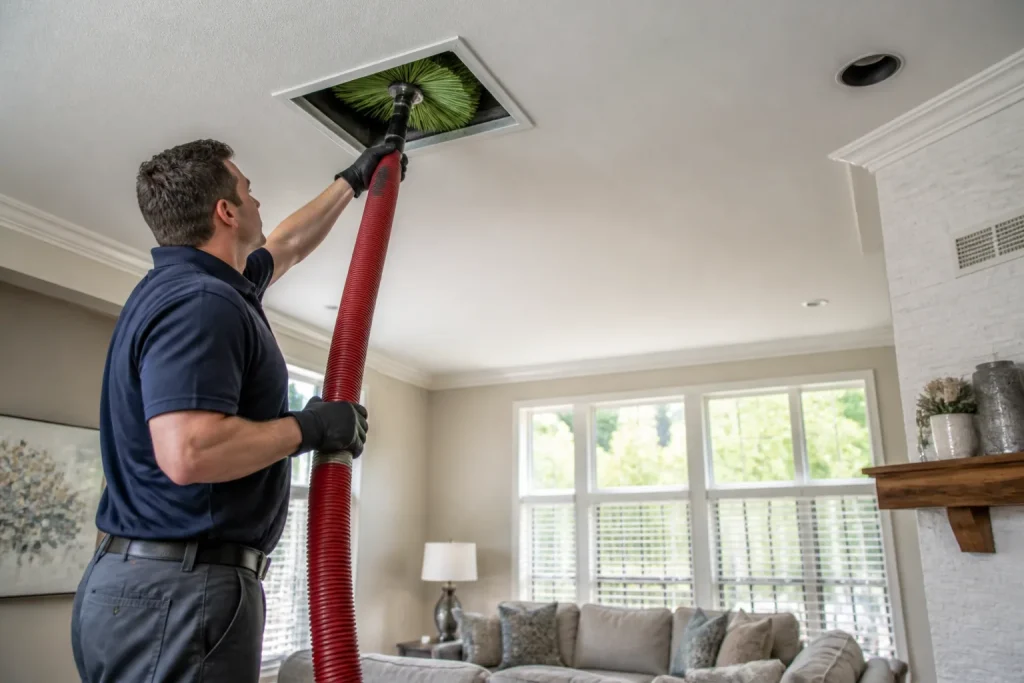
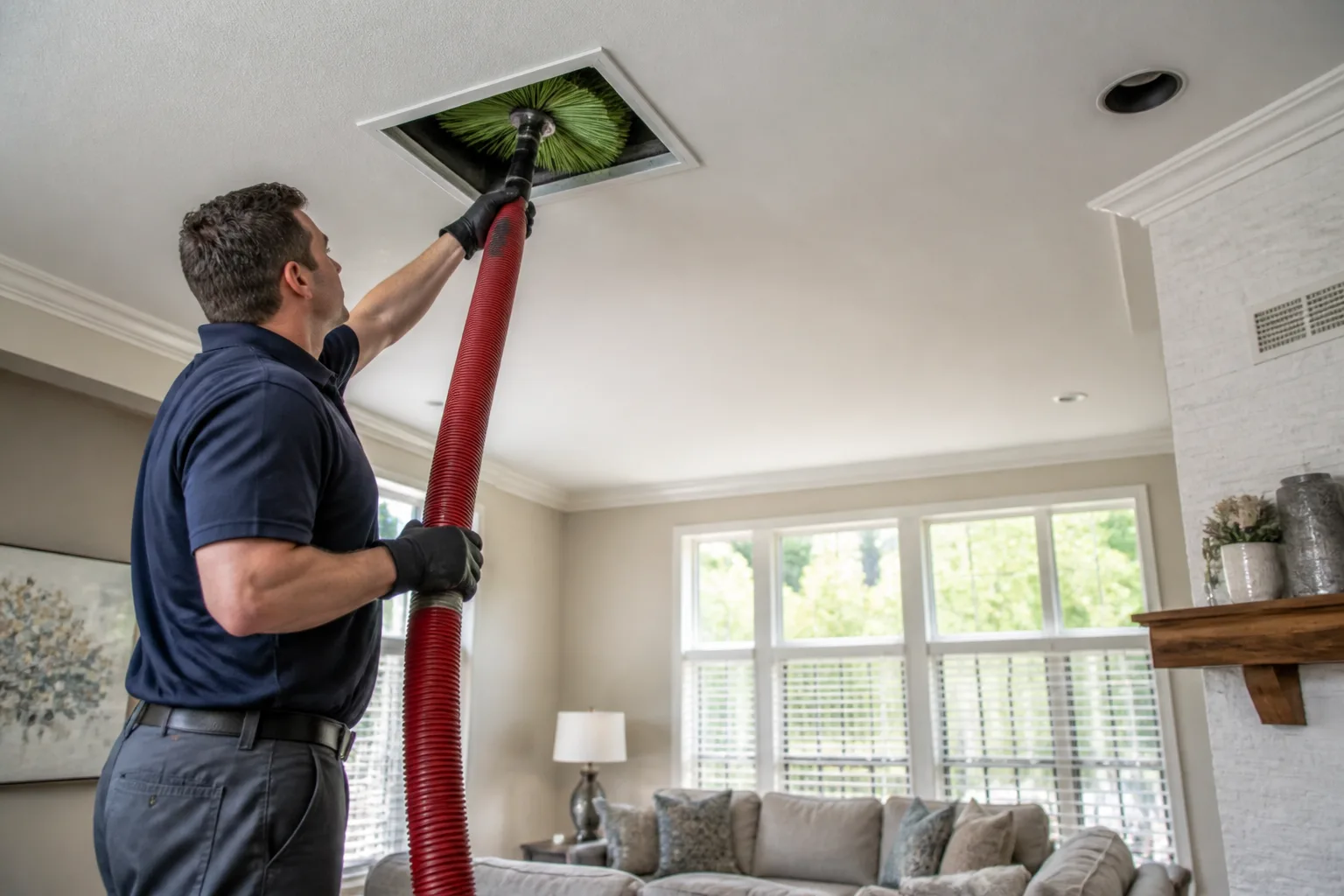
Honeywell Air Duct Cleaning in Ballantyne: A Homeowner’s Guide
Here’s the mistake we see most often with Honeywell whole-home air equipment: a technician cleans every duct in the house, wipes down the vents, and walks right past the electronic air cleaner sitting in the return plenum. That component has been trapping particles around the clock, which means it’s often the dirtiest piece of the entire air pathway. Cleaning around it isn’t cleaning. Honeywell air duct cleaning in Ballantyne means treating that equipment as part of the system it lives in, not as a box bolted to the side of it.
If you’d rather not snake a vacuum through your own ductwork, call (855) 726-7841. We answer 24/7. Fast dispatch from 7am to 7pm, Sunday through Friday.
Why Honeywell Equipment Changes the Cleaning Scope
A standard duct cleaning assumes one thing about filtration: a fiberglass or pleated filter that you swap out every few months. Honeywell whole-home equipment doesn’t work that way, and the difference matters for how a cleaning should be planned and executed.
Honeywell makes several distinct product families that end up inside residential duct systems, and each behaves differently.
- Electronic air cleaners (EACs) charge particles as they pass through and collect them on charged plates. That’s far more aggressive capture than a passive filter, and it means the collection cells load up with a dense, sticky film over time.
- Media filtration cabinets hold a deep-pleat media filter – often four to five inches thick – in a dedicated housing. Longer service life than a one-inch filter, but the housing itself accumulates dust on the upstream side.
- UV germicidal lamps sit inside the air handler or coil cabinet and shine ultraviolet light across the coil and drain pan to limit microbial growth on wet surfaces.
- Whole-home humidifiers tie into the supply plenum and introduce their own maintenance questions, including scale and pad condition.
All four of these live inside the same air pathway the ducts serve, which is why five distinct service categories – duct cleaning, dryer vent cleaning, HVAC cleaning, air quality and sanitizing, and duct repair and sealing – get considered together rather than piecemeal. A Ballantyne home with an EAC in the return plenum isn’t a standard duct job with an accessory attached. The accessory is part of the job.
How to Tell If Your Ballantyne Home Has Honeywell Whole-Home Equipment
Plenty of homeowners in Ballantyne inherit air quality equipment they never chose. It came with the house, or a previous owner had it installed during a renovation, and nobody ever handed over a manual. Here’s how to find out what you’re actually running.
- Look at the filter slot. If you’re pulling out a one-inch pleated filter, you likely have standard filtration only. If there’s a wide cabinet with a thick media filter, or a metal box with a hinged door and a latch, you have something more involved.
- Find the return plenum. That’s the large metal duct just before the air handler. Honeywell EACs and media cabinets mount there, usually with a brand plate on the door.
- Check for a power connection and indicator light. EACs need electricity to charge their cells. A small light or a power cord running to the cabinet is a strong signal.
- Look inside the air handler cabinet for a blue or purple glow. If you see one with the system running, someone installed a UV lamp. Don’t reach in there – just note that it exists.
- Check the thermostat and any wall-mounted control. Honeywell controls are common in Ballantyne homes and sometimes carry a setting for air cleaning or fan circulation tied to the equipment.
Knowing which system you have before you book service changes the estimate. A technician who arrives expecting a filter slot and finds an EAC needs different tools and more time.
UV Germicidal Systems: What They Treat and Why Bulbs Matter
Honeywell UV germicidal lamps are aimed at a specific problem: the evaporator coil and drain pan stay damp for most of the cooling season, and damp surfaces grow things. The lamp shines UV-C across that area to limit that growth. It’s not a whole-house air purifier, and it doesn’t sterilize the air moving through your ducts. It treats a surface.
What surprises people is the maintenance cycle. UV lamps degrade gradually. The bulb keeps glowing long after its germicidal output has fallen off, so the unit looks perfectly operational while doing a fraction of the work it did when new. That’s the trap – no error light, no obvious failure, just diminishing performance. Lamp replacement intervals are set by the manufacturer, so check your unit’s documentation or ask a technician to verify output during a service visit.
During an HVAC cleaning, the coil and drain pan get cleaned mechanically first. A lamp sitting over a dirty coil is doing very little. Cleaning and then confirming the lamp is functioning at spec is the sequence that actually makes a difference in a Ballantyne home.
What a Technician Should Inspect and Document on Honeywell Components
Documentation is where a lot of duct cleaning falls short. Anyone can run a rotary brush through a trunk line; fewer will hand you a record of what they found on your air quality equipment before and after. That record is what tells you whether the work happened.
Before cleaning, expect photos of the return plenum, the collection cells or media filter upstream face, the coil, and the duct interior. After cleaning, the same angles again. With Honeywell equipment specifically, the inspection should cover:
- Collection cell condition on an EAC – cracked plates, arcing marks, and film buildup
- Pre-filter condition and whether it’s been doing its job of catching the big stuff
- Media filter load and whether it’s due for replacement
- UV lamp age, visible output, and whether the quartz sleeve or lamp surface is coated
- Cabinet seals and gaskets – a leaky cabinet door lets unfiltered air bypass the whole system
- Duct connections near the equipment, since a leak there pulls attic or crawlspace air straight into the supply
We use Rotobrush and Nikro extraction systems for the duct work itself, and Abatement Technologies products where containment and contaminant control matter. Those tools let a technician clean the duct interior thoroughly without pushing debris into the air handler, which is a real risk when the equipment cabinet is right there at the end of the run.
Sanitizer Compatibility: Not Every Product Belongs Near an EAC
Here’s a compatibility question that rarely gets asked and should. Duct sanitizing is a named part of what a full-system cleaning involves, and it’s genuinely useful for microbial control and allergen reduction. But systems with electronic air cleaner components need a different approach than plain galvanized ductwork.
Sanitizers vary in formulation, and some are not appropriate for direct application to charged plates, electronic components, or certain media. The equipment manufacturer’s guidance governs here – not a generic “safe for ducts” label. Before any sanitizer goes into a Ballantyne home with Honeywell EAC components, a technician should confirm the product is compatible with that specific equipment and that the electronic components are properly isolated or removed during application. If someone shows up ready to fog the whole system without asking what’s in it, that’s your cue to ask questions.
Where sanitizing is appropriate, the sequence matters: clean mechanically, verify the equipment is dry or protected, apply what’s compatible, and let the system run to clear it. Clean, sealed, and sanitized is the order, and it’s not reversible.
When to Call a Pro
Some maintenance is homeowner territory. Checking your filter, noting an indicator light, and looking for a brand plate on the cabinet are all reasonable. Cleaning collection cells, servicing a UV lamp inside an energized air handler, and assessing duct interior condition are not – the air handler contains live electrical components and moving parts, and a UV lamp should never be handled with the system powered. Call a trained professional for anything past a visual check.
And if your Ballantyne home is showing signs of trouble – musty odors when the system kicks on, uneven airflow between rooms, allergy symptoms that don’t track with the season – the equipment cabinet is one of the first places to look. We find it, we fix it, which is why duct repair and sealing sits alongside cleaning rather than behind it. If a return plenum gasket is failing or a duct run has pulled apart near the air handler, that gets addressed the same visit.
For the duct work itself, air duct cleaning covers the supply and return runs. If your dryer is taking two cycles to dry a load, dryer vent cleaning is a separate job with its own fire-safety weight. And when the coil, blower, and cabinet need attention, HVAC cleaning handles the equipment side of the air pathway.
The Bottom Line
If you have Honeywell equipment in your Ballantyne home, your duct cleaning isn’t a standard job. The electronic air cleaner, media cabinet, or UV lamp is part of the system and needs to be inspected, documented, cleaned, and in some cases replaced as part of the scope. Ask any contractor what they plan to do with the equipment cabinet before they start, and ask for before-and-after photos when they’re done. The answer tells you a lot.
Our technicians have up to 8 years of experience, and we work with Honeywell, Aprilaire, and Abatement Technologies equipment regularly. If you’re in Ballantyne and need help, Air Duct Cleaning Ballantyne offers free estimates. Call (855) 726-7841. We answer 24/7. Fast dispatch from 7am to 7pm, Sunday through Friday.
Frequently Asked Questions
Pricing depends on the size of the system, the number of duct runs, and what equipment is installed in the air pathway. The written estimate sets the final price, and the estimate itself is free. Call (855) 726-7841 for an exact quote – estimates are free.
It can if the technician doesn’t know it’s there. High-pressure air or aggressive brushing applied to charged cells can damage plates and wiring. A technician should identify the equipment before starting, protect or remove the components, and clean the cells separately. Call (855) 726-7841 if you’re not sure what you have.
Collection cells and pre-filters generally need cleaning more often than the ducts themselves, since they’re doing the heavy trapping. Media filters and UV lamps follow manufacturer intervals. A full duct cleaning is a longer cycle. Call (855) 726-7841 and we’ll walk through the schedule for your specific setup – estimates are free.
Not necessarily well. The bulb glows long after its germicidal output has dropped, so visible light is a weak indicator of performance. Output needs to be verified, and replacement follows the manufacturer’s interval. If the unit is sitting over a dirty coil, cleaning comes first anyway. Call (855) 726-7841 to have it checked during a service visit.
For the full range of what we do across the forced-air system, see Air Duct Cleaning Ballantyne.
Written by the team at Air Duct Cleaning Ballantyne.
Need Air Duct Cleaning Help?
Call Air Duct Cleaning Ballantyne - the local pro we connect you with is licensed and insured, with free written estimates in Ballantyne.
(855) 726-7841