
Nikro Air Duct Cleaning in Ballantyne: A Homeowner’s Guide
A shop-vac and a Nikro negative-pressure unit both “clean ducts” the same way a garden hose and a fire truck both “spray water.” One moves a little dust around. The other moves everything out of your system and holds it there until it’s gone. Most homeowners in Ballantyne never learn which machine showed up, because nobody asks. This guide is here to change that: what Nikro equipment actually does inside your ductwork, why it matters in the larger custom homes around here, and how to tell whether the crew you booked is using it.
If you’d rather skip the homework and have someone who knows the difference, call (855) 726-7841 for a free estimate from Air Duct Cleaning Ballantyne.
What Makes Nikro Different From a Shop-Vac?
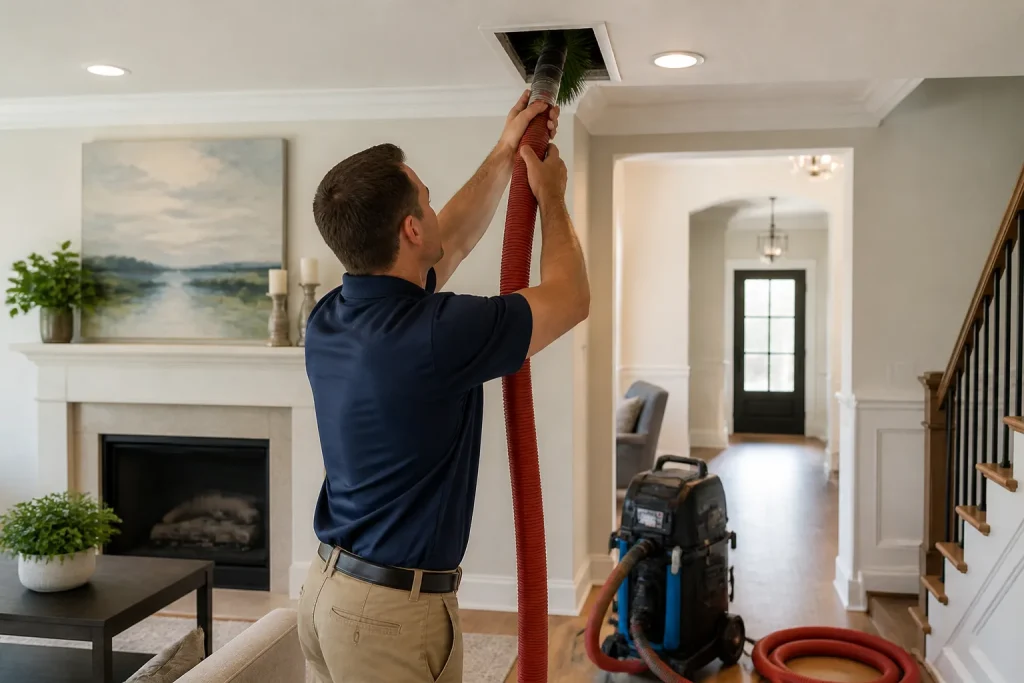
Nikro builds negative-pressure containment systems: a high-volume vacuum unit that connects to your ductwork and pulls the entire system into a state of negative pressure before any brush touches a surface. That’s the whole point. When a technician dislodges dust, debris, or built-up particulate from the inside of a duct, air wants to escape into the room. Under negative pressure it can’t. The contaminant travels toward the vacuum, not toward your living room.
With underpowered equipment, the opposite happens. A shop-vac or a small portable unit can loosen debris without generating enough draw to capture it. Dust puffs out of supply registers, settles on furniture, and lands back on the same surfaces you were trying to protect. Homeowners sometimes describe this as “it got worse before it got better,” which is a polite way of saying the debris was redistributed rather than removed.
Nikro units are also built to run continuously for the length of a whole-home job, not a spot cleaning. That matters in Ballantyne, where three- and four-thousand-square-foot homes with long trunk lines take real draw and real time to clear properly.
How Does CFM Rating Affect Duct Cleaning Results?
CFM stands for cubic feet per minute – the volume of air a vacuum moves. A consumer shop-vac might pull a few dozen CFM at the hose. A professional negative-pressure unit built for ductwork moves hundreds, and it holds that draw while the technician works the full length of the system rather than just the first few feet of a run.
Here’s where the number gets practical. A duct system isn’t one open pipe; it’s a branching network. Air follows the path of least resistance, so a low-draw unit empties the easy branches and leaves debris in the long runs, the returns, and the plenum above the air handler. Higher CFM forces air through those farther sections and carries loosened material all the way back to the collection point.
You don’t need to memorize ratings. You do need to understand the principle:
- Low draw = loosens surface dust in the nearest ducts and drops much of it back into the room.
- Adequate draw = reaches the full length of the longest trunk line and holds the material in containment.
- Containment = negative pressure that keeps the whole system under vacuum during brushing and agitation.
Those three together are why a Nikro-sized unit is spec’d for whole-home systems and not for one vent at a time.
Why Ballantyne Homes Need High-Draw Equipment
Ballantyne’s housing stock skews toward larger custom builds with long trunk lines running from a central mechanical closet out to distant bedrooms, bonus rooms, and finished basements. That layout is comfortable to live in and harder to clean. The farther the register sits from the air handler, the more draw you need to move air and debris through it. A single-story ranch with short runs is forgiving. A sprawling two-story with a long return and multiple zones is not.
We also see a lot of recent renovation work in the area. New flooring, paint, cabinetry, and drywall generate fine particulate that settles into the ducts and stays there. Homeowners who moved in after a remodel often notice a musty smell or extra dust for months without connecting it to the ductwork. High-draw extraction is what pulls that settled material out instead of stirring it up.
And in a market where homes change hands often, many systems have sat through years of ordinary use with no documented cleaning. Long trunk lines plus accumulated buildup is exactly the combination that rewards proper equipment and punishes guesswork.
How Access Points Are Chosen for a Full-System Clean
Equipment alone isn’t enough. Where the technician cuts in matters as much as what they plug in. A proper job maps the whole system first – every supply run, every return, the plenum, the air handler – and then places access points so the vacuum and the brush can reach the full length of each section.
That usually means more than one entry point. On a longer trunk line, a single cut near the air handler leaves the far end untouched. Calculated entry points let the technician work in sections, sealing behind them as they go so negative pressure stays intact across the entire system rather than collapsing at each opening. Nikro units are designed to pair with that sectional approach, which is why the two go together in professional work.
Access points should be cut cleanly and sealed properly when the job is done. If a company leaves open holes behind, that’s a leak – and a leak undoes part of the cleaning the moment the system runs again.
What Else Happens During a Whole-System Clean?
Ductwork is one part of the air pathway. A complete job also addresses the air handler, the blower, the coils, and the return side – and it covers the dryer vent, which is a leading cause of residential fires and deserves its own attention rather than a quick pass. This is where working with a company set up for the full system matters. We clean the ducts, handle HVAC cleaning on the mechanical components, and finish with the sanitizing and air-quality work that keeps results from fading.
Nikro handles extraction. Rotobrush handles the rotary brushing that agitates surfaces inside the duct. Abatement Technologies products support containment and contaminant control. Honeywell and Aprilaire components give homeowners a path to filtration and humidity improvement after the cleaning is done. Different tools, one job: clean, sealed, and sanitized from the vent cover to the air handler.
That sequencing is the difference between an air duct cleaning and a system reset. If your dryer vent is due too, dryer vent cleaning is worth booking alongside.
When to Call a Pro
Some signs are obvious: visible dust blowing from registers right after the system kicks on, a musty smell that gets stronger when the heat or AC runs, allergy symptoms that clear when you leave the house, or airflow that’s noticeably weaker in one room than another. Others are quieter – a recent renovation, a move into a home with no cleaning record, or a system that just hasn’t been touched in years.
We’d rather you understand the equipment before you book than wonder afterward what happened. Nikro, Rotobrush, and the rest aren’t upsell words; they’re the difference between debris leaving your ductwork and debris finding a new home in your living room. Our technicians have up to 8 years of experience working with these systems, and we explain findings before we touch anything.
Related services in Ballantyne: air duct cleaning, HVAC cleaning, dryer vent cleaning, air quality and sanitizing, and duct repair and sealing.
The Bottom Line
Equipment brand is a legitimate vetting question. Ask what machine will be on your driveway before you book. A Nikro negative-pressure system holds your ductwork under vacuum so loosened debris is captured rather than recirculated, and it’s sized for whole-home systems with the long trunk lines common in Ballantyne. Pair that with carefully placed access points and a crew that can also repair what it finds, and the job is finished properly the first time.
If you’re in Ballantyne and need help, Air Duct Cleaning Ballantyne offers free estimates – call (855) 726-7841. We answer 24/7. Fast dispatch from 7am to 7pm, Sunday through Friday. One flat price per system agreed before work starts, before-and-after photos of your own ducts, and a satisfaction guarantee.
Frequently Asked Questions
Yes. Nikro is the brand of negative-pressure equipment, and “regular” cleaning often means a portable vacuum with far less draw. Nikro units hold the entire duct system under vacuum during brushing, so dislodged debris is captured at the source instead of puffing into your rooms. Call (855) 726-7841 for an exact quote – estimates are free.
Cost is set per job by a written estimate, based on the size of your system, the number of trunk lines, and what we find inside. We don’t quote per vent and we don’t use teaser pricing that grows once we’re on site – one flat price per system, agreed before work starts. Call (855) 726-7841 for an exact quote – estimates are free.
Ask for before-and-after photos of your own ductwork, taken during the job. We provide them as standard. You can also confirm what equipment will be used before booking – if a company can’t tell you the brand and the containment method, keep asking. Call (855) 726-7841 for an exact quote – estimates are free.
Most homes don’t need it yearly. Renovation, a recent move, pets, allergy symptoms, or visible debris at the registers are better triggers than a calendar. Larger Ballantyne homes with long runs and heavy occupancy tend to need it sooner. Call (855) 726-7841 for an exact quote – estimates are free.
Written by the team at Air Duct Cleaning Ballantyne.
Need Air Duct Cleaning Help?
Call Air Duct Cleaning Ballantyne - the local pro we connect you with is licensed and insured, with free written estimates in Ballantyne.
(855) 726-7841